August 8, 2016 saw the birth of our third grandchildren, a girl named Natalie, in Louisville, KY. Of course, a visit to Kentucky was immediately scheduled. Here the grandparents pose with Natalie, her sister Catherine, her brother Christopher, and her proud parents Allison and Josh.
I used the opportunity to visit the Blue Grass Scenic Railroad and Museum in Versailles, Kentucky.
This railroad is a treasure, and has many items and features not found on other tourist railroads--including a 2 MPH speed restriction! (To be explained later, below). Although they only have 5.5 miles of track, the 90-minute ride was GREAT! The track was built by the Louisville Southern Railroad in 1889 to link Louisville and Lexington.
This tourist line is completely run with volunteers and trains run on Saturdays and Sundays with an occasional charter during the week.
A Wiki-pedia history of this railroad is at the end of this Blog.
I arrived several hours early and had time to explore the grounds before anyone else arrived. There are many displays, each having a sign explaining the item.
These ex-army cars have been refurbished by a Boy Scout for his project.
To me, the most interesting item is the very early railroad track, which was strap iron attached to limestone rocks. These were discovered near Lexington and moved to the Museum site.
Inside the Museum was another rock with a piece of strap iron attached.
A large room in the depot was devoted to railroad items and displays.
The railroad crew and personnel were very cordial, and invited me to their conference room while they ate their lunch and to 'talk trains'!!
Then it was time to get the train ready for a train ride. Our power today is a GP8, originally a GP7 built for the Reading Railroad. Later it was upgraded in the Paducah, Kentucky railroad shops and designated a GP8. These units are known as "Paducah Rebuilds."
Our train will have four passenger cars, three tourist class cars and one first class car (which has air conditioning).
The last three cars are ex-commuter cars and the tail end car has been painted for high visibility during the shove move back to the depot.
The controls for the conductor who mans this car on the shove back.
Signs along the depot wall give the history of each of the cars and locomotives.
The railroad's other main locomotive is this Norfolk & Western GP-9.
Also operable is this Fairbanks & Morse H-12-44.
Our crew today are brothers, Engineer Mike Walker and Brakeman Steve Walker. Steve will be the engineer on tomorrow's train. Both are big railfans and travel the country to watch trains, they like restoring railroad artifacts, and have model trains. (Sounds like someone else I know).
Let's go for a train ride!! As we leave the siding to enter the main track, we pass under the "new" signal tower. Engineer Mike enjoyed this SOUTHERN Railroad signal as he grew up, and when it was discarded, he got it and restored it. Each light is toggled to light either green or red for special photos.
There are many small crossings on the railroad. Note the unique SOUTHERN whistle post. Instead of the traditional W posts that we see, these signs have the whistle pattern of two long, one short, and a long.
With a non-functioning speedometer in the cab, a GPS serves as the speedometer. The track is rated for 15 MPH but the max speed for the excursions is 10 MPH.
This part of Kentucky is covered with beautiful horse farms with large brown fences. Here is a small horse farm along our route.
Tobacco formerly was a big cash crop in Kentucky. I only saw one tobacco field while I was in the Blue Grass State and it was along this rail line.
And there are still a lot of tobacco barns, even if they are no longer used for tobacco.
At Abbott, people exit the train to picnic or pick their pumpkins during the Pumpkin Train runs.
We approach the half way point and the small village of Milner.
Along the route there is a siding with several vintage cars awaiting restoration. First is a flat car with six-wheel trucks that formerly hauled Army tanks.
Next is a milk car that still holds 2 large stainless steel tanks. This should definitely be restored and saved for display!
And, a small crane and dynamometer car round out the siding.
Here is the 2 MPH speed restriction. A while ago, a storm washed out the track here and it is about a 200-foot drop down the cliff to the right. So the railroad relaid the track and imposed the 2 MPH speed restriction.
There are several rock cuts along this section which are very narrow and scenic!
It would be really hard to change ties out at these locations. There isn't room to slide a tie in or out. So several ties would have to be removed and then slid or repositioned at an angle to get them out!
The grade through here down to the Kentucky River is 1.3 % so trains must be under control!
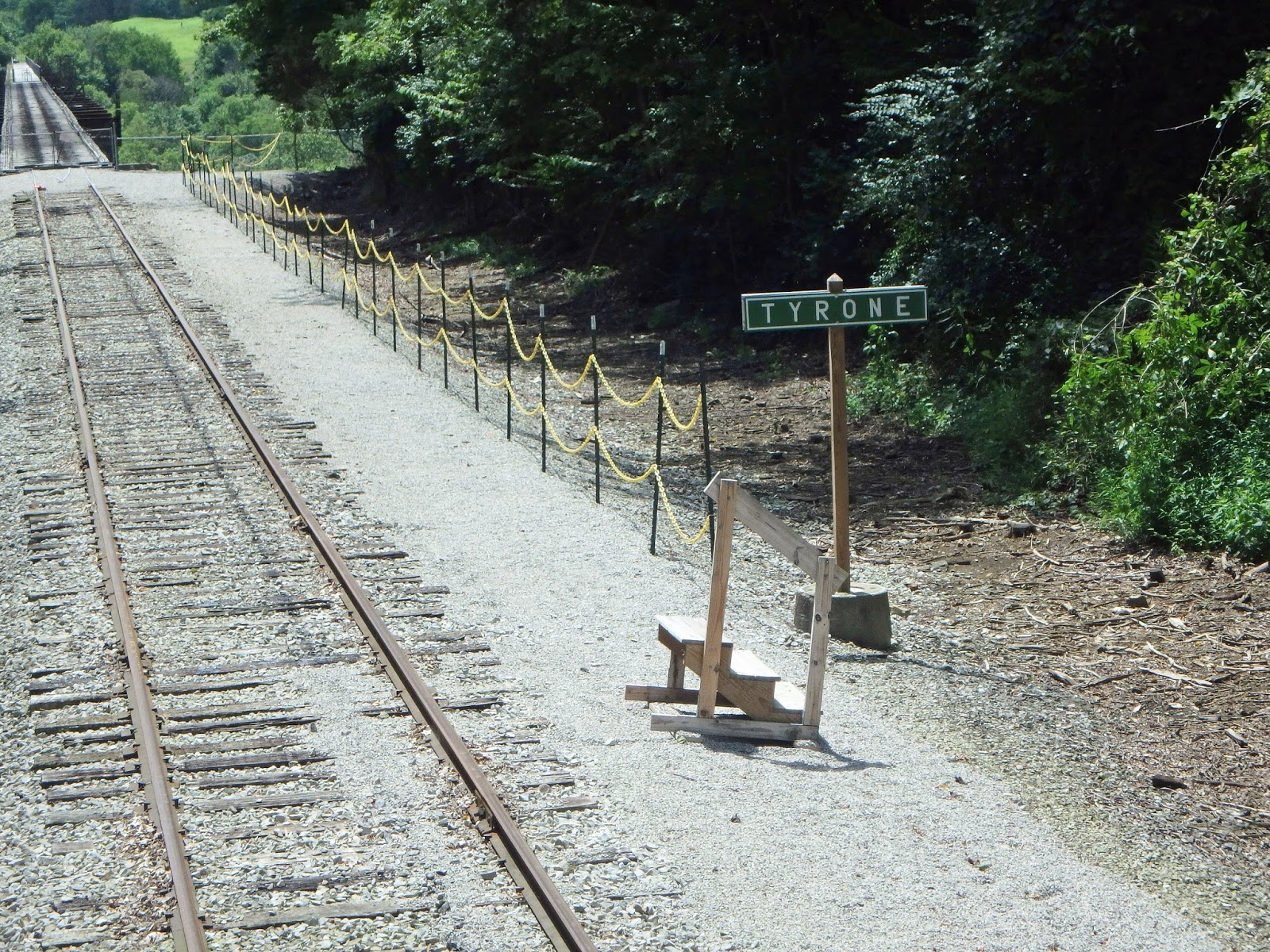
Very near the end of the line is Tyrone. Besides the siding showing, there was a long siding down the hill to the river to the Tyrone Power Plant. The Power Plant is the main reason this railroad existed, as cars of coal were brought into the plant. There was a runaway train here some years ago so procedures were changed to force the crew to stop and throw two switches to line the track down the hill to the plant.
On the siding are 5 cabooses, privately owned. The owner planned (still planning??) to use them for a Bed and Breakfast operation. But years of deterioration and vandalism will mean a lot of work!
Around the corner is the end of the railroad's track. The large trestle, Young's High Bridge, had the rail removed a few years ago. After stopping, passengers are allowed to disembark and walk up to the bridge for easy viewing. Built in 1889, the trestle is 263 feet tall and 1,653 feet long.
The left side of the bridge. People aren't allowed on the bridge but a bunge group has built an access from the other end and frequently jumps off this bridge.
The right side of the bridge.
Also crossing the bridge is Highway 62 with an S-curve bridge, reportedly the only highway S-curve bridge in the country. Note the Wild Turkey Distillery at the top of the hill.
I wanted a picture of this bridge from the Highway so I took Highway 62 home. But, there was a car following me (about 10 feet behind!) so I couldn't even slow down. Here is a pic from the Internet.
 As passengers view the valley and bridge, they are allowed to get pictures on the engine.
Time to shove back to the depot.
As passengers view the valley and bridge, they are allowed to get pictures on the engine.
Time to shove back to the depot.
Thanks to the Blue Grass Scenic Railroad for a GREAT ride and hospitality. This is definitely one of the funnest tourist railroads I have been on!!!!
HISTORY
The rail line was originally built by the Louisville Southern Railroad in the 1880s. For a brief time it was leased by the MONON Railroad. Later, it became part of the Southern Railway.
While operated by the Southern, a switching accident at the Tyrone
Generating Station caused coal shipments to be received by truck, and
hastened the end of the usefulness of this portion of the line. Later,
the Norfolk Southern Railway
operated the line. A few years into NS ownership, the portion of the
line between the Kentucky River and Versailles was slated for
abandonment, and subsequently sold to the museum. The line from the
Kentucky River to Lawrenceburg, Kentucky was abandoned and sold to a
scrapper in 2009. The rails on Young's High Bridge and into Lawrenceburg
were then quickly removed and sold for scrap. Young's High Bridge
itself has been bought by a private party who have formed a LLC to
develop the area into a tourist attraction. Vertigo Bungee, a loose band
of thrill-seeking adrenaline junkies known for appearances on MTV
sports since the 1990s, has since developed Young's High Bridge into a
permanent bungee jumping platform. Young's High Bridge is now considered
to be the highest permanent platform bridge jump in North America.
Meanwhile, the railroad line from Versailles to Lexington has been sold
first to the Lexington and Ohio Railroad and now to the R.J. Corman Railroad/Central Kentucky Lines.
I was asked by the North Shore Scenic Railroad staff to pilot the NARCOA (North America Railcar Operators of America) ride on July 5, 2016. Railcars are commonly called speeders or putt-putts and there are hundreds of people around the country that own their own cars and travel long distances for the opportunity to 'ride the rails.'
There were 19 cars for this year's ride, including one hy-rail owned by Fred Lonnes of Illinois that would trail the cars. Fred is a very experienced operator and frequently operates with excursion coordinator Michael Ford of Indianapolis. Although most operators were from the Midwest, there was a family of four from Texas, a family from New Mexico, and two cars from Arizona!
Michael Ford is coordinating a rides on 8 different railroads. Two days previous, many of these cars rode the St. Croix Valley Railroad from Rush City, MN to Hinckley in back. In two days from now, many of these people will ride in North Dakota. And then, many of the cars will go to Canada for rides on six different railroads!!!
Operators set their cars on at Marbles, just outside of Two Harbors for the trip to Duluth and back.
Come along and view some of the sights on our way to Duluth!
Remember, these pictures are taken from a moving vehicle (steel on steel!) traveling 20-25 MPH and some are taken through the windshield! And they have been down-sized.
First shot, crossing the Knife River.
Approaching Palmers.
Crossing the Sucker River.
There are several sections of tangent track (long straight sections)
Crossing the French River.
Crossing the Talmadge River.
Now we start getting into East Duluth, or Lakeside, where there is a lot of traffic (and a lot of crazy drivers!)
Heading down Lemon Drop Hill, our steepest grade.
Passing by Leif Erickson Park.
And approaching Fitger's Brewery.
We are going on a boat cruise but we had time before the boat leaves, so all speeders were turned around on a bike/pedestrian path for the trip back north later in the day. This couple was from Michigan and had just returned from a speeder trip at Tuscaloosa, Alabama!
And here is CJ Pappas, an engineer on the Union Pacific Railroad, with his Milwaukee Road car.
And the speeders are all turned and going back to Harbor Drive for the boat ride. The first young couple are from Iowa and his folks had a speeder also, right behind them.
One of the highlights of these speeder rides is the Harbor Cruise. People get to see Duluth from a different angle and the narration gives history of Duluth, explains many of the industries that are passed, and gives lots of shipwreck history. Here is our boat today.
Anchored right behind our boat was this Ice Breaker. (Too bad we couldn't use it for the cruise!)
The iconic symbol of Duluth is the Lift Bridge and we go under it to pass from the Harbor into Lake Superior.
Here are 3 views of Duluth from the Lake. The narration points out many highlights.
Back in the Harbor, we pass many industries. This large facility exports mostly wheat.
And these wind turbines were brought in by ship and are going to Iowa.
Tugboats aren't used much any more now that modern ships have their bow thrusters to help them maneuver.
Of real interest to me is this old Interstate Bridge. Before the large Blatnick Bridge (and the Bong Bridge further south) in the background were built, this small bridge was the only road connection between Superior and Duluth--AND it carried trains also. The portion of the bridge that is left is a fishing pier for local residents.
I find this "Seagull Island" amazing with its thousands of seagulls. Where do they find enough food for all of them?? And, can you imagine the mess they leave behind??
The only ship in port was the Paul Tregurtha, loading coal at Midwest Energy.
And we get right down by the former DM&IR iron ore docks, now owned by Canadian National (CN). The dock on the left is no longer used.
We then went to the Museum for a box lunch and viewing the Museum pieces. I again went through the Abraham Lincoln replica funeral car. This car was commissioned by President Lincoln but was delivered shortly after he was assassinated so he never saw it. After Lincoln's burial, no President ever used it.
VERY INTERESTINGLY--one of the speeder riders was a man who helped make this car. AND--while I was going through the car again, a man on board was vacationing from Kenosha and he was one of the chief wood workers on this car. I spent a lot of time with him learning about the car!
It was time to head back north to Marbles and load the speeders onto trailers. A couple of shots on the way.
Crossing the French River.
Crossing the Sucker River.
Crossing Knife River.
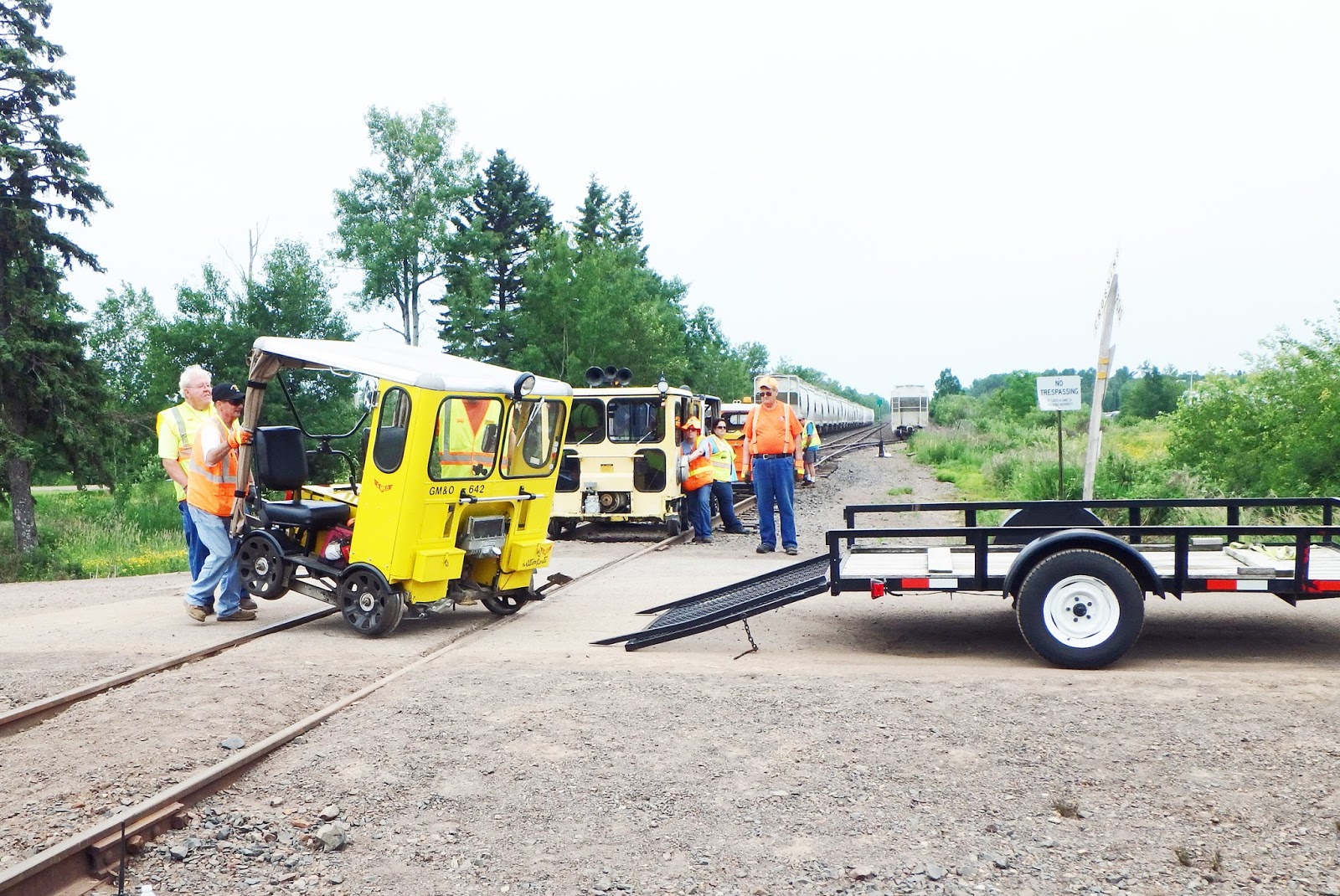
Loading the speeders. Some speeders have a turntable underneath which is lowered and the car easily turned. Other cars are picked up by handles and turned around.
Here is the family from New Mexico, loading their car and ready to head to Fordville, North Dakota for another speeder adventure! Note that their car as a "Rio Grande Railroad" logo.
Thanks to Operations Manager Max Medlin and the North Shore Scenic Railroad for allowing me another rail adventure!