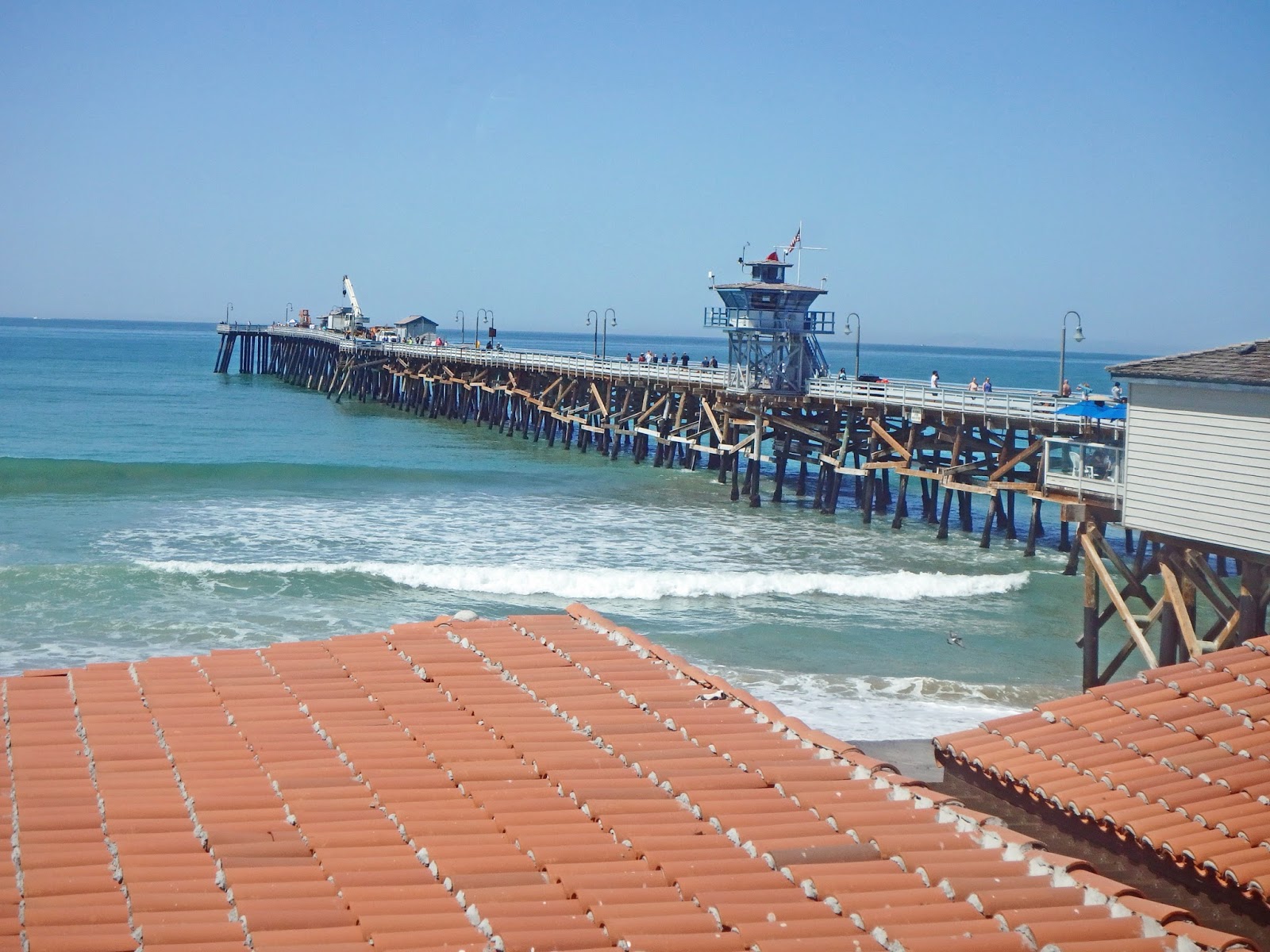
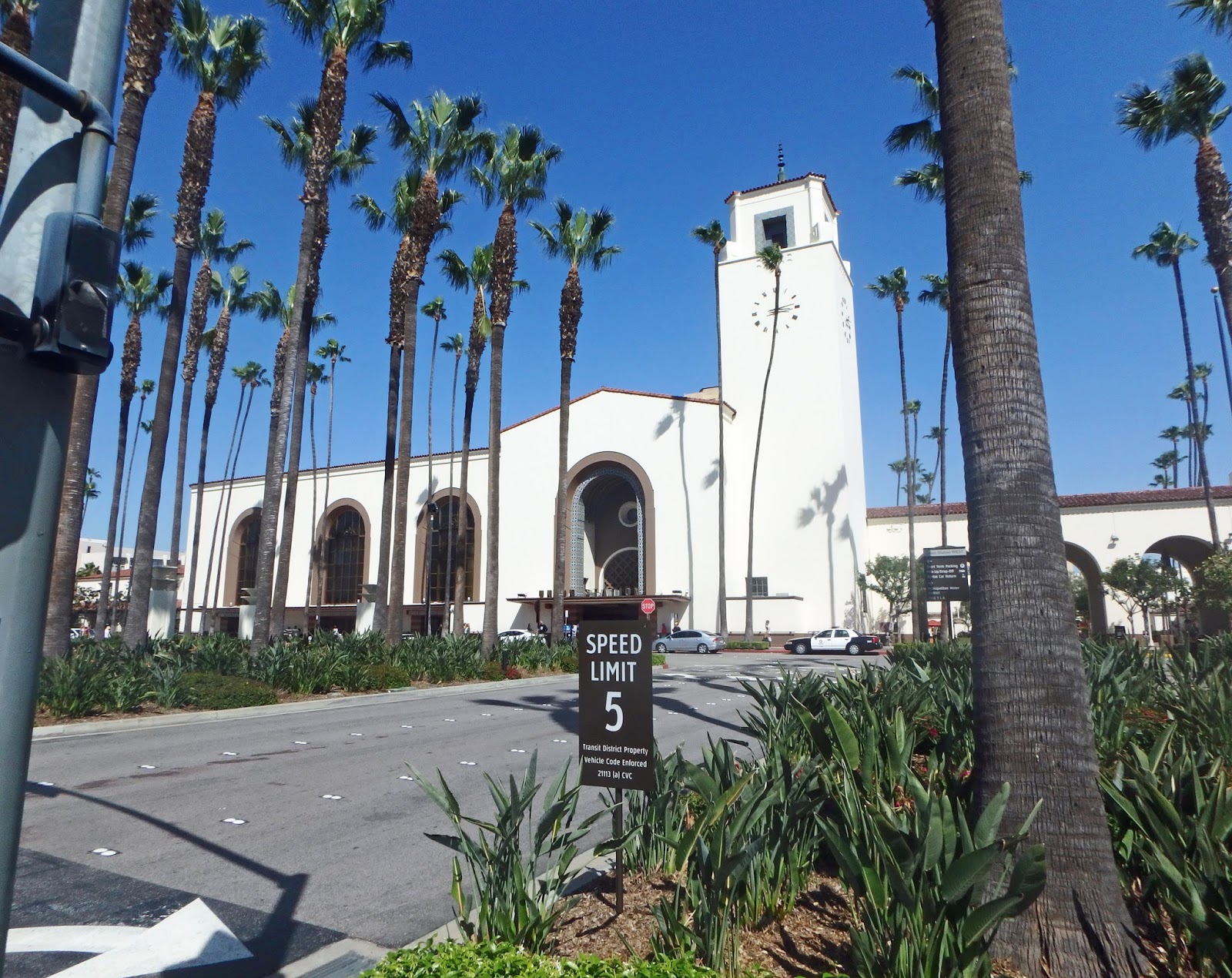
Friend Brian Sykes of Atlanta recently required from the Norfolk Southern Railroad. He asked me to join him on a 5-day railfan trip of southern California. Here is what we did on Day 1.
First thing we did was inspect the Los Angeles/Long Beach intermodal facility. The Union Pacific Intermodal Facility covers 237 acres and has 6 loading
and unloading tracks, running 24/7. It has an annual capacity of
580,000 containers. It was built in 1986 at a cost of more than $55
million. It includes the Ports of Los Angeles and Long Beach. Union
Pacific's support yard has 15 classification tracks capable of handling
100,000 feet of cars. The Port of Long Beach is undergoing a
modernization program to enhance rail efficiency and expand on-dock rail
capacity. The project includes removing existing track and laying
29,000 feet of new track. BNSF has access over the UP but is in the
process of working toward construction of their own near-dock railyard.
Access is very easy with public highways going through the facility.
Here are some pictures to illustrate the massiveness of this facility!


Pacific Harbor Line, Inc. provides rail transportation, maintenance and
dispatching services to the Ports of Long Beach and Los Angeles, which
together form the largest container port in the United States. In
addition to switching over 40,000 units of carload freight annually, PHL
provides rail switching services for nine on-dock intermodal terminals
and provides dispatching services for about 140 intermodal or unit
trains per day. PHL connects with BNSF and UP.
Leaving the intermodal facility, we followed the tracks that bring the trains to this area. There are a lot of trains daily, and when the facility was built, they traveled at 10 MPH through the business district, blocking many crossings for extended periods. The solution was the construction of the Alameda Corridor. It is a 20-mile freight rail expressway that connects the national rail system with the Ports.
The most notable feature of this corridor is the Mid-Corridor Trench, a below ground, triple-tracked rail line that is 10 miles long, 33 feet deep, and 50 feet wide. It is shared by the BNSF and UP railroads. The corridor allows trains to bypass 90 miles of early 20-th century branch lines and avoids more than 200 street level railroad crossings. Maximum train speed is 40 MPH.
Construction
began in April 1997. Operations began in April 2002. Train capacity is 150 trains per day.
We follow a stack train toward the trench. At the beginning, the track is at street level.
Soon it ducks down into the trench.
Here you can see the tracks formerly used to carry the trains at street level.
Looking down into the trench, it is difficult to see the trains because of the cross members.
We leave the trench and stop and visit this abandoned interlocking tower. These towers guarded crossing tracks but are not used nowadays and most have been torn down. This tower is Hobart Tower at San Pedro Junction.

We next visit the Fullerton, California Train Depot. The present Santa Fe Depot replaced the original Victorian depot that
was constructed in 1888, a year after the arrival of the railroad in
Fullerton. Built slightly east of the old depot, this poured-in-place
concrete structure is about 256 feet long (plus a 150-long covered
platform), designed in a Spanish Colonial style. The building's long,
low-profile shape appears as a composite of forms, each with distinct
features, which are assembled in a linear fashion. Arches of varying
profiles appear throughout the building, while the use of a staggered
gable and shed roofs with Mission tile adds to the visual complexity of
the whole. This style of architecture is fully developed, with a
fanciful use of detailing, such as quatrefoil windows, wooden shutters,
concrete grillwork and a Monterey style balcony.
Brian Sykes admires the beauty of this classic Santa Fe depot.
A listing of all the daily passenger trains that pass through Fullerton.
And here is one of the Amtrak trains.
There is an overhead crosswalk for passengers to get to the other side of the tracks safely. It's a great place to take pictures.
Trains are running almost continually and this one came through with 8 engines.
A Metrolink train slipped in when we weren't watching and waits for the commuter run later in the day. Metrolink is a commuter or regional rail system in Southern California consisting of 7 lines and 61 stations operating on 534 miles of track. It was founded in 1991 as the Southern California Regional Rail Authority and its average weekday ridership in 2017 was 39,838 people.
Soon a Surfliner train pulls in. This is one train I've always wanted to ride and we changed our trains to do that on Day 2 of the trip. The Pacific Surfliner is a 350-mile passenger train service operated by Amtrak on the coast of Southern California between San Diego and San Luis Obispo. It carried 2,924,117 people in 2016.
Beside the Santa Fe depot is this classic Union Pacific depot, now a restaurant.
On the way to Colton Crossing, we catch a Metrolink train.
Colton Crossing is a railroad crossing in Colton, CA. According to Wikipedia, it was first built in 1883 and the site of one of the most intense frog wars in railroad construction history, leading to a personal confrontation between famed lawman Virgil Earp and California Governor Robert Waterman. It was the crossing of the former Santa Fe and Southern Pacific Railroads. We could drive right in here and watch trains. We noted another vehicle and in it was "William Foamer," (that's his Facebook page name) and he gave us lots of information on watching trains.
To alleviate traffic congestion, this flyover was built. Here a loaded coal train crosses headed by two CSX units.
Tomorrow, day 2, we go train riding!